
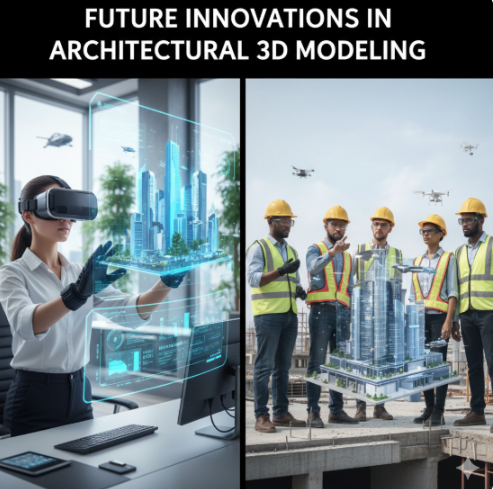
The architecture world is changing quickly to accommodate wider digital technology, new sustainability standards, and changing expectations of clients. Architectural 3D modeling is already influencing the way buildings are conceived, verified, and sold. But current software and workflows are just transitional steps. As we look to the future of architectural 3D modeling, dynamic, connected, and immersive environments promise to redefine design and delivery.
Architectural 3D Modeling of Tomorrow will become smarter, more connected, and more immersive, transforming every stage of architectural design and construction.
As this transformation takes place, 3D modeling will transition from primitive design and presentation tools to comprehensive decision support platforms that integrate data, performance targets, and environmental factors through every phase of a project‘s life.
Smarter, Data-Integrated 3D Models
The biggest step forward will be the convergence of form, oriented 3D models with data, rich, intelligent models. Future architectural 3D models will not only be able to communicate form and design intent, but will carry performance data, thermal and acoustical characteristic information, material data, environmental impacts data, and potential future deconstruction information.
Designers will be able to control energy efficiency, carbon footprint, and material use all from a single 3D environment. Any geometric or material alterations will instantly update performance data to make sure that decisions reflect up-to-date, evidence-based information. This change will take 3D models from digital sketches to analytical tools that guide design decisions.
Connection to AI and Process Automation
AI will become built into future architectural 3D modeling. Architect-designed AI tools will help identify what can be optimized based on a building site, code constraints, and project performance goals, quickly generate design options, and quickly identify potential problems.
For example, computers will interpret limitations such as site constraints, requirements for daylight and view, and mandated environmental impacts, and generate initial building shapes and flows. Architects will be able to consult with a digital design assistant that indicates the best solutions available for the parameters. Automating certain procedures, such as data cleaning, clash detection, and documentation, will give designers more time for innovative solutions.
Real-Time Performance Evaluation
While current 3D models can run kinetic simulations, future models will be able to runKID tests on things like daylight, airflow, comfort, and energy consumption during design iterations, confirming how different building variables impact performance.
Design changes will immediately show how the changes influence factors like daylight levels or internal air flow. This ongoing feedback loop will help establish sustainable design solutions early, rather than as afterthoughts. All project team members will access and work from the same current model, making collaboration smoother.
The Expansion of Digital Twins
Digital twin technology will be a defining influence on future architectural 3D modeling. A digital twin is a three-dimensional model that monitors and reflects a real-world building, structure, or system in near-real time, integrating digital data flows with live physical data on parameters, performance, and operating conditions.
In the future, models will no longer become outdated after buildings are built. Instead, they will evolve into useful digital twins, linked with facility monitoring systems, that help manage energy, optimize performance, and extend the value of a project.
XR-enabled Experiences
Virtual reality, augmented reality, and mixed reality will be more fully woven into architectural workflows.
Design scenarios will be experienced at one, to, one, physical scales, rather than through flat computer screens. Stakeholders will take full-scale walkthroughs, review design options, and discuss ideas directly within virtual environments that instantly communicate size, space, and context. XR will reinforce design ideas and promote consensus between specialists, clients, and non-technical participants.
Web-based Collaborative 3D Design
Architectural 3D modeling environments of the future will leverage the cloud. Digital 3D projects will be accessible, stored, sent, and manipulated by distributed teams all over the world. This focus on cloud-based 3D design will enable:
- Cooperative multiuser modeling
- Efficient remote design charrettes
- Faster collaboration among disciplines
- Reduced design conflicts, omitted versions, and data corruptions
Online working groups will make the design process more open and adaptable, even in highly multidisciplinary work. Advanced 3D design and 3D visualization company will be an element of a connected digital network.
A Sustainable, First Mindset
Designs will not just be greener; they will be greener by design. Future software tools will incorporate quantifiable views of embodied energy, embodied carbon, ecological impact, and integrated resource cycling into every stage of the process.
Design teams will be able to compare scenarios side, by, side quantitatively in order to optimize their ecological results. This ongoing transparency will inspire future-proof, resilient designs.
Leading technologies such as procedural modeling and infinite variation parametric modeling will deliver rapid change responsiveness in future projects, all supported through easy, to, use interfaces that extend openness and creativity to a broad constellation of users.
Less Separation Between Design And Construction
Pre- and post-design expectations will converge. Future models will more directly reflect actual construction processes.
Expected benefits will include:
- Modular component production with detailed shop drawings
- Closer pairing of digital models with construction workflows
- Almost real-time shop fabrication direction
Reduced production errors or overstock, better use of resources, and enhanced quality control. Built models will also serve as accurate as built records.
Future models will incorporate far more information on human use than just geometry and physics. They will embody people walking through spaces, being affected by acoustics, and reading signs.
Designs informed by building users’ cognitive mapping, noise, visual comfort, and crowding will become more natural and intuitive.
More Accessible
The evolution of modeling programs and increasing automation means that more users will be able to successfully work on increasingly intricate, professional projects. Smaller firms, boutique studios, and individual architects will be able to operate cutting-edge workflows without onerous hardware investments. This expansion of digital design standards will win more recognition for excellent, responsible architecture.
Conclusion
The future is electric 3D modeling, smarter, more comprehensive, more immersive, and more performance-aware. Experiences with digital twins, artificial intelligence, augmented reality, and collaborative online design will be a hallmark of tomorrow‘s architectural processes. Builders will converge on ever-closer alignments of physical and digital worlds.
This trajectory will drive new inventive architectures that are responsive and resilient to the real issues facing buildings today. Buildings developed by specialists trained in the latest 3D techniques will offer their owners timeless advantages through design, construction, operation, and sustainability.
In the near future, a dedicated 3D presentation expert could help expand your current practice toward a strategic lens that leverages visualizations to spearhead designs and address scalable, virtuous solutions. Simulation platforms will evolve into architectural decision support tools as we move even further into the realm of integrated, globalized design.
